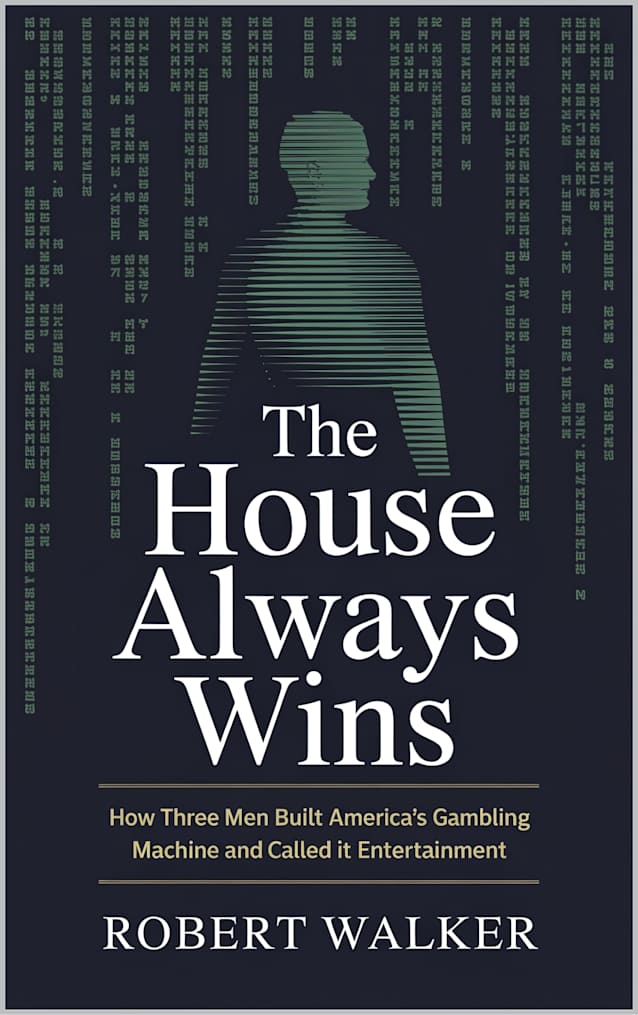
The House Always Wins : How Three Men Built America’s Gambling Machine and Called It Entertainment
About
The definitive inside account of how DraftKings built a $6 billion gambling empire and convinced America it was entertainment.
“A book that demands transparency from its subject owes the same transparency to its reader.” — From the Author’s Note
In 2012, three colleagues quit their jobs at a business card company and built a fantasy sports app in a spare bedroom. By 2026, their company deployed behavioral analytics that could identify a user’s psychological vulnerability — and used that identification not to protect her, but to send a push notification at 11:47 PM offering fifty dollars to keep gambling.
THE HOUSE ALWAYS WINS is the first book to trace DraftKings’ complete arc — from the “dead team” insight that launched daily fantasy sports, through the regulatory crisis that nearly destroyed the industry, to the Supreme Court decision that legalized sports betting, and finally to the prediction market pivot that may bypass state gambling laws entirely.
Drawing on SEC filings, court documents, patent records, class-action discovery materials, and earnings call transcripts, Robert Walker reveals:
- How 847 separate A/B tests produced the forty-seven characters of text most likely to convert a user’s moment of financial despair into a deposit
- How 3.8% of users generate 42% of the company’s revenue — and how the algorithm identifies and targets them
- How the same economic activity was repackaged under three legal labels — “game of skill,” “legal sportsbook,” and “financial exchange” — while the money flowed in the same direction
- How the company’s AI now controls 70% of promotional spending and is replacing the human engineers who built it
- The 130-year pattern connecting 1890s bucket shops to today’s prediction markets — and why the regulatory gap always closes
Walker writes with the authority of a thirty-five-year sports betting industry veteran who met with DraftKings’ co-founders when PASPA first fell. He writes with the precision of an investigator who tracked every dollar through SEC filings and every algorithm through patent records. And he writes with the moral complexity of a narrator who refuses to reduce the founders to villains or the users to victims.
The innovation was real. The exploitation was also real. They share a root.
This book shows the reader both truths simultaneously — and lets the reader hold the weight.
For readers of Bad Blood, Empire of Pain, and The Big Short.